How to Choose an Energy Meter: Finder’s 7E and 7M Series

An energy meter is one of the central components of any electrical system: In addition to measuring the energy consumed, it provides the data needed to monitor consumption and optimize resource use in real time. With technological advancements, meters have evolved from simple electromechanical devices to advanced digital instruments capable of communicating directly with distribution networks, control systems, and users via apps and displays.
From analogue devices to smart meters
Electronic and smart meters, which have now replaced analogue systems, use transducers to measure voltage and current. The collected data is processed digitally and stored in the memory.
While the LCD display facilitates immediate on-site data viewing, the remote connection allows for managing multiple rate plans, monitoring consumption in real time, and detecting any anomalies. With smart meters, energy measurement is evolving: These devices go beyond simply recording consumption, as they can communicate with energy management systems, ensuring continuous monitoring of the system.
MID certification: What is it, and when is it mandatory?
To ensure that a measurement is not only accurate but also has legal validity, the MID Directive (Measuring Instruments Directive 2014/32/EU) comes into play, requiring the use of certified meters. This requirement applies to activities such as billing for consumption, sub-metering, or accounting for energy generated by photovoltaic systems.
To ensure accurate and legally valid measurements, every MID-certified meter undergoes specific tests and calibrations. This compliance is indicated directly on the meter via the CE marking, the “M” symbol, and the year of certification.
Energy Phases and Flows: How to Navigate Your Choice
The structure of the electrical grid and energy needs determine the type of meter required. For small offices and residential customers, single-phase or two-phase devices are used. Commercial, industrial, or high-load settings require three-phase meters.
Today, with the widespread adoption of self-generation power systems (such as solar power and energy storage systems), the choice of meter must also take into account the direction of the electrical flow. It is therefore essential to distinguish between unidirectional meters, which measure only the energy drawn from the grid, and bidirectional meters, which record both the import and export of electricity.
Communication Protocols
To transmit this volume of data to monitoring systems, modern meters use specific communication protocols, including:
- Modbus RS485: historically used in industrial settings to cover long connection distances and ensure immunity to interference.
- M-Bus: developed specifically for remote meter reading. It is widely used in residential buildings and the commercial sector.
- Pulse output (S0): an interface that indicates energy consumption through a sequence of electrical signals.
The integration of these standards enables accurate and immediate monitoring of consumption parameters. Within the Finder product line, all this data is consolidated in Energy Pulse, an energy management system.
The Finder Range for Energy Metering
To enable flexible consumption management, Finder has developed two different Series of energy meters, both featuring MID-certified models.
7E Series: Precise measurement and instant reading
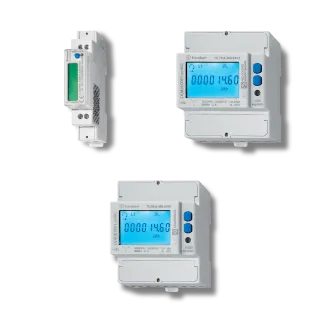
The 7E Series is the ideal range of meters for installations where the priority is precise, certified, and easy-to-read measurement, without the need for complex on-site programming. These devices are designed for installation in residential or industrial electrical panels, and are suitable for both local data viewing and integration into linear remote-reading networks.
The range has recently been expanded with the new Type 7E.85, a multifunction bidirectional energy meter with dual or single-rate capabilities for three-phase systems (3- or 4-wire). This model integrates both the M-Bus and Modbus RS485 interfaces, as well as a dual S0 output.
The 7E Series models are available with either a backlit LCD screen or a classic mechanical counter, the latter having the advantage of allowing data to be read even when the device is turned off.

7M Series: NFC connectivity and smart management
The 7M Series, addresses the challenges of modern energy management, where metering must not only be precise but also integrable, smart, and configurable in the field.
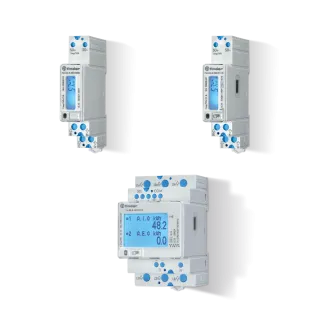
Featuring backlit LCD displays and MID certification, the 7M Series combines Modbus RS485 or M-Bus protocols and S0 pulse outputs with a distinctive feature: Integrated NFC technology (depending on the model). This connectivity simplifies commissioning and maintenance. Using a smartphone and the Finder Toolbox app, users can configure meter parameters and read consumption data directly from their smartphone.
The range includes the single-phase Type 7M.24 (up to 40 A) and the three-phase Type 7M.38 (up to 80 A), both capable of tracking both energy consumption and energy feed-in (making them ideal for photovoltaic systems and EV charging stations). Both ensure accurate measurements even at high temperatures and provide immediate communication with management software.

7E Series or 7M Series: Which one should you choose for your system?
In summary, the choice between the two series depends on the type of application:
- The 7E Series is designed for those who prefer a traditional approach to installation and data retrieval. Although it includes technologically advanced, bidirectional models (such as the 7E.85), reading and interaction take place on-site in the traditional way, directly via the device’s physical buttons.
- The 7M Series is the right choice for those who need speed and flexibility in system management. Thanks to NFC, it’s possible to program functions and view parameters in just a few seconds via a smartphone.
In both cases, MID certification (depending on the model) ensures the accuracy and transparency of readings, offering an additional guarantee to the end customer.