Smart water management: Finder OPTA for the Consorzio Acque Risorgive
The Acque Risorgive Consortium coordinates public interventions and private activities in the fields of hydraulic defense and irrigation, overseeing a 100,000-hectare territory across the provinces of Padua, Venice, and Treviso. Managing sluice gates within a natural oasis presents a significant technical challenge: it requires granular control and an uncommon level of environmental resistance.
In this context, the Acque Risorgive Consortium needed to move beyond static facility management, identifying a technological partner capable of offering operational flexibility without compromising the industrial ruggedness required to operate in critical environments, often characterized by extreme temperature fluctuations.

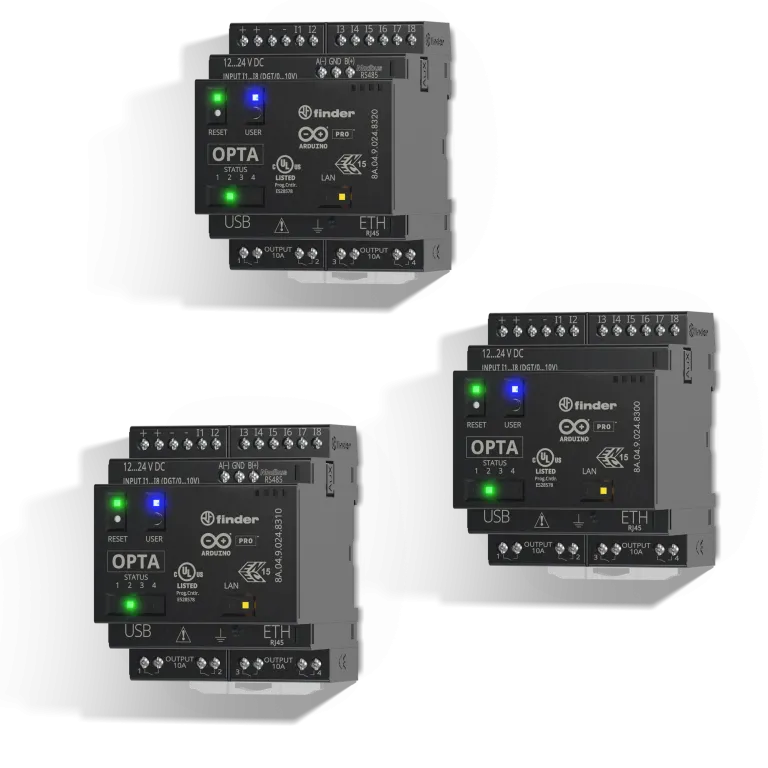
System integrator Evomatic Srl identified Finder OPTA as the ideal solution. OPTA, Finder’s Programmable Logic Relay (PLR), combines the safety and reliability typical of a PLC with the connectivity potential of an advanced IoT device. The device’s ability to be programmed according to the IEC 61131-3 standard enabled the implementation of complex timing and regulation logic while maintaining the compact form factor of a smart relay.
The versatility of the device allows Evomatic to deploy it in three key roles within their proprietary EvoSCADA-IoT platform:
- OPTA as a Bridge: The device acts as a bidirectional interface between existing PLCs and the cloud platform, ensuring compatibility with various communication protocols, including MQTT, HTTP, FTP, OPCUA, RS485, Modbus TCP, and Modbus RTU.
- OPTA as an Advanced PLC: Leveraging programming via the Arduino IDE, it is possible to utilize open-source libraries or develop custom solutions; support for OTA (Over-The-Air) updates radically simplifies system maintenance and evolution.
- OPTA as a Gateway/Data Concentrator: The device operates as a “one-to-many” collection node, aggregating data from sensors distributed across the territory and transmitting it centrally to the EvoSCADA-IoT platform.
Additionally, the integrated Bluetooth module allows operators to perform immediate device diagnostics and manage the facility directly in the field using a dedicated app.

Integration with the IoT Cloud has radically transformed the Consortium’s operations, making facility management predictive and optimized. Today, operators can monitor and adjust water levels remotely, reacting in real-time to weather conditions to preserve the oasis ecosystem and improve phytodepuration processes. This case study demonstrates how adopting advanced technology, such as that offered by Finder OPTA (further information available at opta.findernet.com), can lead the transition toward intelligent ecosystem control, combining ease of use with controlled management and the mitigation of hydraulic risk for the benefit of the entire territory.