Designing independence at the house of Decibel
Finder supports the school project focused on accessibility

There are projects that take root in the classroom and have the power to go beyond the school gates to become part of people’s lives. It all began at the “Amaldi Sraffa” Industrial Institute on the outskirts of Turin (Italy), where students in the 4ᵃ class launched an initiative that uses automation to promote inclusion.
At the heart of the project is Casa dei Decibel, “the House of Decibel”, a facility that houses six Deaf adults. Here, actions that many take for granted can become complex daily challenges, both for the residents and for the staff providing round-the-clock care. The idea stems from the desire to use technology in a practical way, offering solutions capable of making life simpler and more accessible for those who live in the residential facility.
The students, guided by Professor Umberto Cadili, developed a project entirely tailored to the residents of Casa dei Decibel. The first step was a site visit: The students entered the facility, studied the spaces, and, above all, got to know the residents, listening to their needs to design an environment that would first and foremost meet their requirements.
Integrating Finder solutions into the project
After transferring their findings to a digital floor plan, the students identified three key solutions, based on the Finder product range (such as certain YESLY solutions and the BLISS programmable thermostat), to simplify and automate home management:
- Dimmable lights to adjust brightness according to different times of the day;
- Remotely controllable digital thermostats;
- Automated blinds.
Other elements include the installation of movement sensors for automatic water flushing, and range extenders in the hallways to amplify the Wi-Fi signal of other Finder devices. The added value of the system lies in the Scenarios: Sequences of coordinated actions that are activated with a single command, transforming the atmosphere of the home in an instant.
A fundamental aspect of the design was the care with which the students envisioned the possible integration of the devices: Every solution was tested by users before being incorporated into the project, ensuring that the innovation was a shared choice. The transition will also be gradual: Guests will be able to continue using traditional controls until they have become fully comfortable with the new digital systems.
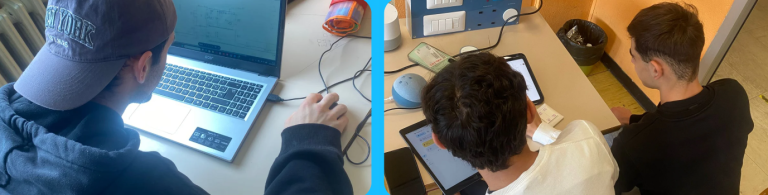
The value of the project: Designing Autonomy at Casa dei Decibel
The project, which lasted for about four months, saw the students divide into specialized groups. Each student contributed by handling the selection of materials, or the devices’ programming or communication. Finder provided support by supplying the products, but the credit for the overall vision goes to these students, who took the project to heart by combining humanity with technical expertise. Now that the design phase is complete, an electrical installer will carry-out the implementation.
The value of this project lies in the hands of the professionals of the future—young people capable of giving deep meaning to their work and who, behind every electrical connection, see an opportunity to build a more accessible world.